
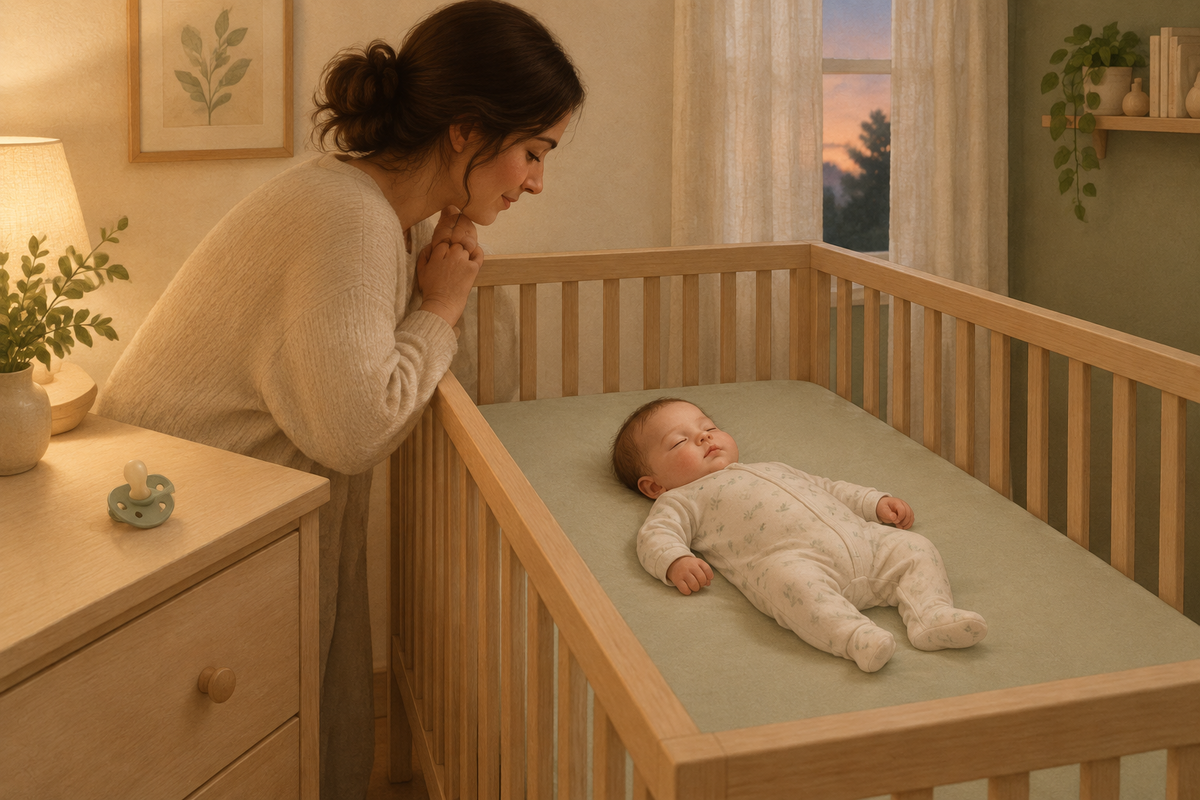
Little Questions. Gentler Nights.
A practical parent-first guide to the pacifier question that comes up just as everyone finally falls asleep.
If your baby’s pacifier falls out after they have fallen asleep, you do not need to put it back in. The American Academy of Pediatrics (AAP) recommends offering a pacifier at naps and bedtime because its use is associated with a lower risk of sudden infant death syndrome (SIDS)—even when it falls out later. If your baby wakes up, respond to their needs; you can offer a pacifier again while they are awake, but never force it or attach it to clothing or bedding.
The house is finally quiet. Your baby is asleep. Then you notice the pacifier has slipped out, and suddenly there’s a new question: Should I sneak into the crib and put it back before my baby wakes?
The reassuring part is that a sleeping baby does not need a pacifier replaced just to keep it in their mouth. What matters is knowing the difference between a pacifier that falls out during sleep and a baby who actually wakes and needs help.

If the pacifier falls out but your baby stays asleep, what should you do?
Usually, nothing. You can let your baby continue sleeping. According to the AAP’s safe sleep guidance, parents do not need to reinsert a pacifier once an infant has fallen asleep. The association between pacifier use at sleep onset and lower SIDS risk does not require the pacifier to remain in the mouth all night.
That means you do not need to watch the monitor waiting for it to fall out, or wake a peacefully sleeping baby to fix it. There is also no need to use a clip, strap or soft toy to keep the pacifier close. In fact, those attachments can create serious hazards during sleep.
Offer at sleep time. Do not force. Do not reinsert after sleep begins. A pacifier is one optional part of safer sleep practices—not a substitute for a safe crib and sleep position.
What if your baby wakes up and cries when the pacifier falls out?
That is a slightly different situation. If your baby is awake and upset, you can respond to them as you normally would. For some babies, a clean, appropriate pacifier may help them settle. For others, the real need may be feeding, a diaper change, illness-related discomfort or reassurance. A pacifier should not be used to delay needed feeds.
A gentle nighttime response
- Check what is happening. Is your baby truly awake and asking for help, or briefly moving and resettling?
- Consider basic needs. Feeding cues, a wet diaper, discomfort or sickness deserve attention before assuming the pacifier is the only issue.
- Offer soothing while baby is awake. You may offer the pacifier again if your baby wants it, without pushing or forcing it into their mouth.
- Return to a safe sleep setup. Place your baby on their back in their own firm, flat, clear sleep space when putting them down.
If your baby frequently needs help settling, discuss your questions with their pediatrician. Not all frequent waking is caused by pacifiers, and there is no universal method that works for every baby or developmental stage.

Does pacifier use reduce SIDS risk if it falls out?
The AAP recommends offering a pacifier when putting a baby down for naps and nighttime sleep. Research has found an association between this practice and a lower risk of SIDS. The exact mechanism is not fully understood, and the recommendation still applies when the pacifier falls out after a baby falls asleep.
The NIH Safe to Sleep® program gives the same practical direction: if the pacifier falls out during sleep, there is no need to replace it. The program also notes that it is fine if a baby does not want a pacifier.
A pacifier is not a guarantee against SIDS. Continue to follow the more important foundations of safer infant sleep: back sleeping, a firm flat mattress, a properly fitted sheet and no loose blankets, pillows or soft objects in the sleep area.
Can you use a pacifier clip or attached stuffed animal at bedtime?
No—not during infant sleep. Do not clip a pacifier to pajamas, a sleep sack or other clothing, and do not attach it to a ribbon, cord, blanket or stuffed toy. A strap or attachment can create strangulation, choking or suffocation risks. A pacifier used for sleep should be plain and unattached.
- Choose a pacifier appropriate for your baby’s age and inspect it for cracks, damage or loose parts.
- Keep strings, clips, plush pacifier holders and blankets out of the infant sleep space.
- Do not coat a pacifier with honey or other sweet liquids.
- If your baby does not want a pacifier, do not force it.
What about breastfed babies and newborns?
The AAP recommends waiting until breastfeeding is well established before offering a pacifier for sleep. In practical terms, feeding should be going comfortably and effectively, with appropriate weight gain. If your baby is not breastfeeding, the AAP says you may offer a pacifier earlier.
If you are unsure whether breastfeeding is established, or your baby has feeding or weight-gain concerns, ask your pediatrician or lactation professional rather than relying on a fixed number of weeks. For newborns, pacifiers must never replace hunger cues or scheduled feeds advised by your clinician.
How can you keep bedtime predictable without relying on a pacifier staying in?
There is no need to build your entire bedtime routine around keeping a pacifier in place. A few consistent steps can help you and your baby recognize that sleep time is approaching, whether a pacifier stays in or not.
- Keep the steps simple: feeding as needed, a diaper check, quieter lights and a brief calming routine.
- Offer the pacifier when placing baby down if your baby likes it; accept that it may fall out.
- Use a clear, safe crib, bassinet or play yard with the baby placed on their back.
- Dress your baby appropriately for the actual room conditions rather than adding loose bedding.
- If a pattern of repeated waking worries you, talk through feeding, comfort and sleep questions with your pediatrician.
Think of the pacifier as an option you offer at the start of sleep, not something you must manage all night. The simpler the sleep space, the less you need to worry about objects, attachments and repositioning.

Parent checklist: safe pacifier use at bedtime
Myth vs. fact: three things parents often hear
Pediatric guidance, without the guesswork
Both the AAP and NIH give consistent advice: offer a pacifier for sleep if your baby wants one, do not reinsert it after sleep begins and never attach it to things in the sleep environment. These recommendations are general infant safe-sleep guidance, not an individual diagnosis or a substitute for advice about your baby’s feeding or medical needs.
You can read the primary guidance directly in the two sources linked above. There is no special pacifier, sleep sack or commercial product proven to prevent SIDS.
Frequently asked questions
Do I need to put my baby’s pacifier back in after it falls out during sleep?
No. The American Academy of Pediatrics says you do not need to reinsert a pacifier after your baby falls asleep. If your baby stays asleep, you can leave it where it is.
What if my baby wakes up crying because the pacifier fell out?
Respond to your baby and check for feeding or other needs. If your baby is awake, you may gently offer a clean, age-appropriate pacifier again, but do not force it. You do not have to replace it repeatedly while your baby is sleeping.
Does a pacifier still help reduce SIDS risk if it falls out?
The American Academy of Pediatrics says pacifier use at naps and bedtime is associated with a lower risk of SIDS, even if it falls out after the baby falls asleep. A pacifier does not replace safe sleep practices.
Is it safe to attach a pacifier clip to a sleep sack or pajamas?
No. Do not attach pacifiers to clothing, sleep sacks, strings, blankets or stuffed toys while a baby sleeps. These attachments can create choking, strangulation or suffocation hazards.
When can a breastfed baby start using a pacifier for sleep?
The AAP recommends waiting until breastfeeding is well established before offering a pacifier. Families who are not breastfeeding may offer one earlier. Ask your pediatrician or lactation professional if feeding is not going smoothly.
For more on your baby’s sleep routine, read Why Your Baby Won’t Nap Unless Held and Baby Waking Up Crying at Night?
If you are reviewing sleep clothing alongside your bedtime routine, our TOG Rating Chart explains insulation and room-based layering. A properly fitted, non-weighted wearable blanket can be an alternative to loose blankets; it is not a remedy for pacifier waking.
Explore more practical parent-first answers, from safe sleep spaces to comfortable bedtime layers.
EXPLORE THE SLUMBER LAB →This article offers general parenting information for infants. If you have questions about your child’s feeding, growth, breathing, or health, consult your pediatrician.


Leave a comment
This site is protected by hCaptcha and the hCaptcha Privacy Policy and Terms of Service apply.