
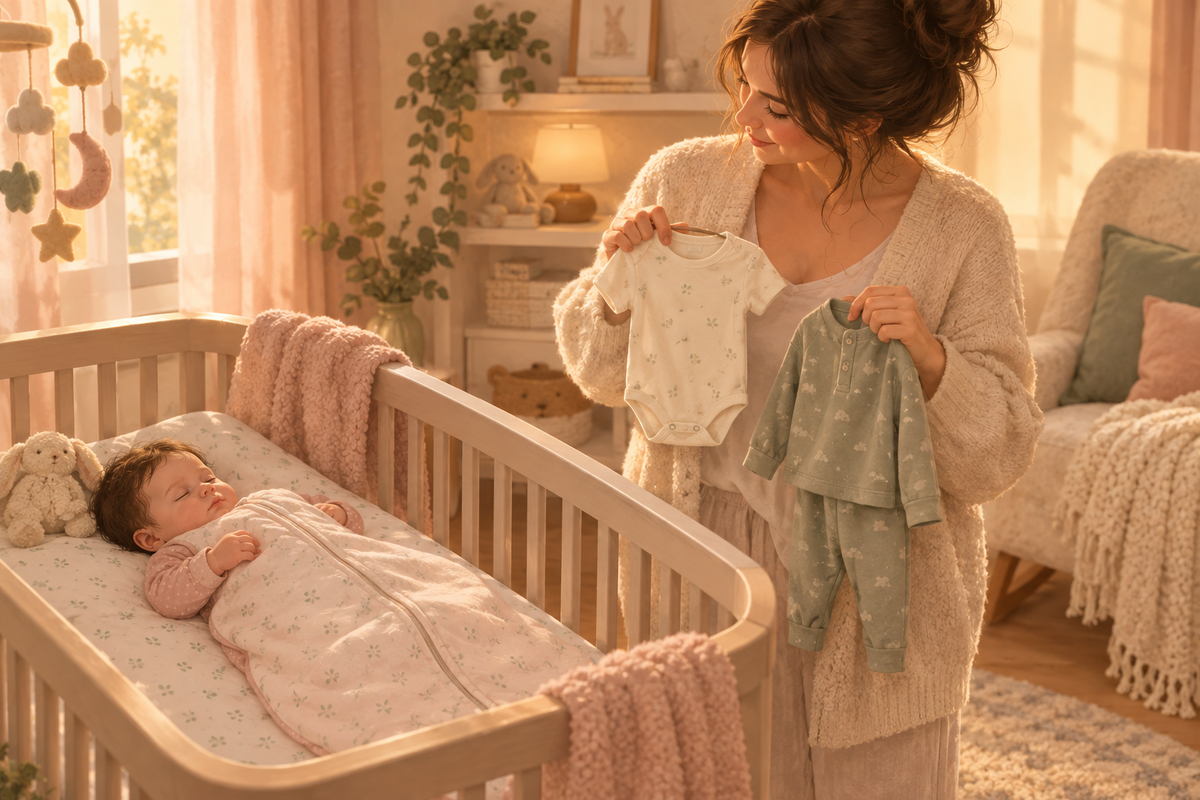
What Should My Baby Wear Under a Sleep Sack? A Simple Layering Guide
Quick Answer
```What your baby wears under a sleep sack depends on the sleep sack's TOG, the room conditions, the clothing underneath, and your baby's comfort.
A lightweight sleep sack may be paired with a short-sleeve bodysuit in a warm room, while a cooler room may call for lightweight pajamas or another appropriate layer.
There is no single outfit that works for every baby every night. Use the sleep sack manufacturer's guidance as your starting point, avoid overheating, and check your baby's chest or upper back rather than relying only on their hands and feet.
```What should a baby wear under a sleep sack?
It sounds simple until you're standing in front of the dresser at bedtime wondering:
“Bodysuit? Pajamas? Another layer? Is this too much?”
The good news is that you don't need to memorize a complicated formula.
Think of your baby's sleep outfit as a combination of room conditions + clothing underneath + sleep sack.
The goal is simple: keep your baby comfortably warm without overheating.
The NIH's Safe to Sleep® program recommends dressing babies in clothing suitable for the room temperature and notes that wearable blankets can provide warmth without adding loose items to the sleep area. NIH Safe to Sleep®

Do Babies Wear Pajamas Under a Sleep Sack?
Yes, they can.
A sleep sack is designed to be worn over sleep clothing, so pajamas underneath are a normal combination.
But that does not mean your baby needs thick pajamas every night.
A lightweight bodysuit may be enough in a warm room. Lightweight pajamas may make more sense when the room is cooler. The sleep sack's TOG also changes the overall warmth of the outfit.
The simple idea:
```Room conditions + clothing underneath + sleep sack = the overall sleep outfit.
```Why the Layers Under the Sleep Sack Matter
It's easy to think, “The sleep sack keeps my baby warm, so whatever is underneath doesn't matter.”
But it does.
A thin bodysuit and thick fleece pajamas create very different overall outfits when paired with the same sleep sack.
That's why a sleep sack that feels comfortable with one outfit may feel too warm with another.
Instead of thinking about the sleep sack by itself, look at the entire sleep outfit.
What Can My Baby Wear Under a Sleep Sack?
Short-Sleeve Bodysuit
A short-sleeve bodysuit can be a simple lightweight base layer, especially when the room is warm and the sleep sack is lightweight.
This can be especially practical during warmer months when full pajamas would make the overall outfit feel unnecessarily warm.
Long-Sleeve Bodysuit
A long-sleeve bodysuit adds more coverage while keeping the outfit relatively simple.
It can be a useful middle option when a short-sleeve layer feels too light but thicker pajamas would be more than your baby needs.
Lightweight Pajamas
Lightweight pajamas or a sleepsuit under a sleep sack are another common combination.
This can make sense in a cooler sleep environment when a bodysuit alone does not feel like enough.
Very Light Clothing in a Warm Room
In particularly warm conditions, some babies may need very little underneath a lightweight sleep sack.
The key is to look at the entire outfit and your baby's comfort rather than assuming every baby needs the same number of layers.
What Should My Baby Wear Under a 0.5 TOG Sleep Sack?
A 0.5 TOG sleep sack is a lightweight option, so parents often pair it with a lighter base layer.
Depending on the room and the clothing itself, that may mean:
- a short-sleeve bodysuit
- a lightweight long-sleeve layer
- lightweight pajamas
- or a very minimal layer in particularly warm conditions
The important part is that 0.5 TOG does not automatically tell you exactly what your baby should wear underneath.
The complete outfit still matters.
Bubble Panda tip:
```Think of TOG as one piece of the puzzle—not a complete outfit formula.
```For warmer sleep environments, explore Bubble Panda's bamboo 0.5 TOG sleep sacks .
What Should My Baby Wear Under a 1.0 TOG Sleep Sack?
A 1.0 TOG sleep sack provides more insulation than a 0.5 TOG option, so the clothing underneath can be adjusted according to the room conditions.
A reasonable starting point may be:
- a short- or long-sleeve bodysuit
- lightweight pajamas
- another lightweight base layer appropriate for the environment
But don't automatically add thick pajamas just because the sleep sack is 1.0 TOG.
Same sleep sack, different outfit:
```1.0 TOG + lightweight bodysuit = lighter overall combination
1.0 TOG + thick fleece pajamas = much warmer overall combination
```What About a 2.5 TOG Sleep Sack?
A warmer sleep sack is generally intended for cooler sleep environments.
With a higher-TOG sleep sack, you may need fewer or lighter clothing layers underneath than you might expect.
That doesn't mean a 2.5 TOG sleep sack requires one specific outfit. Always follow the manufacturer's guidance for the specific product.
Don't solve every temperature question by adding another layer.
How Do I Choose the Right Layer?
When you're standing in front of the dresser wondering whether to grab the bodysuit or pajamas, ask yourself four questions.
Look at the actual sleep environment rather than dressing your baby based only on the weather outside.
A higher TOG generally means a warmer sleep sack. Use the manufacturer's guidance for the specific product.
A thin bodysuit and thick fleece pajamas are very different layers, even under the same sleep sack.
Check your baby's chest or upper back for signs that the overall outfit is too warm.

Check Your Baby, Not Just the Thermometer
The NIH Safe to Sleep® program recommends avoiding overheating, dressing baby appropriately for the room temperature, and watching for signs such as sweating, flushing, hot skin, or a chest that feels hot. NIH Safe to Sleep® guidance
When checking your baby, focus on:
```- Chest
- Upper back
- Signs of sweating
- Overall comfort
Signs Your Baby May Be Too Warm
- sweating
- very warm or hot skin
- a hot chest or upper back
- flushed or red skin
- obvious signs of discomfort
If your baby feels hot or sweaty, remove a layer and reassess rather than automatically adding more clothing.
What About Cold Hands?
Cold hands and feet do not automatically mean that your baby needs another layer.
Instead of judging your baby's overall warmth from their extremities alone, check the chest or upper back.
“Should I Put a Onesie Under a Sleep Sack?”
A bodysuit can be a perfectly reasonable base layer.
The question isn't whether a onesie is required. It's whether the combination makes sense for the room and the sleep sack.
In a warmer room with a lightweight sleep sack, a short-sleeve bodysuit may be enough.
In a cooler environment, a long-sleeve bodysuit or lightweight pajamas may make more sense.
“Can My Baby Wear Footie Pajamas Under a Sleep Sack?”
Yes, footed pajamas can be worn under a sleep sack.
Just consider the warmth of the pajamas together with the TOG of the sleep sack.
Thick fleece pajamas under a warm sleep sack can create a much warmer combination than lightweight cotton pajamas under the same sleep sack.
Also make sure the sleep sack is the correct size and fits securely according to the manufacturer's instructions.
“Can My Baby Wear Two Layers Under a Sleep Sack?”
Sometimes an additional clothing layer may be appropriate in a cooler environment.
But more layers are not automatically better.
Look at the total warmth of the outfit rather than simply counting pieces of clothing.
If your baby already has a warm sleep sack, adding another thick layer underneath may make the combination too warm.
A Simple Layering Method for Parents
Check the TOG rating and the manufacturer's recommended clothing combinations.
Start with lightweight clothing rather than automatically piling on layers.
Keep your baby's head and face uncovered and keep loose bedding and soft objects out of the sleep space.
Feel the chest or upper back. If your baby is hot or sweaty, reduce a layer and reassess.
Common Mistakes Parents Make
Mistake #1: Dressing for the season instead of the room
“It's winter” or “It's summer” doesn't tell you exactly how warm your baby's sleep environment is.
Mistake #2: Treating TOG as the entire outfit
The clothing underneath still contributes to the overall warmth.
Mistake #3: Adding layers because the hands feel cold
Cool hands and feet do not automatically mean that your baby needs more clothing.
Mistake #4: Adding a loose blanket over the sleep sack
A sleep sack is already a wearable layer. When more warmth is needed, adjust the clothing underneath or choose an appropriate TOG rather than adding loose bedding.
Mistake #5: Forgetting about overheating
Parents naturally worry about babies being cold, but overheating matters too. Sweating or a hot chest can be a sign that your baby is too warm.
Bubble Panda Expert Tip
```Don't try to build the perfect outfit. Build an adjustable outfit.
Start with a sensible base layer, then use your baby's comfort as feedback. Indoor temperatures change, babies grow quickly, and the same sleep sack can feel different when the clothing underneath changes.
```
What If My Baby Keeps Feeling Too Hot?
Start by taking away one layer rather than completely changing the bedtime routine.
Sleep Sack TOG → Clothing Underneath → Room Conditions → Baby's Comfort
If your baby is sweaty or their chest feels hot, remove a layer and reassess.
Safe to Sleep® also advises keeping your baby's head and face uncovered and avoiding hats indoors because they can contribute to overheating. NIH Safe to Sleep®
What If My Baby Seems Cold?
If your baby's chest or upper back feels cool, review the clothing underneath and the sleep sack's TOG.
Depending on the manufacturer's recommendations and the sleep environment, you may consider a lightweight additional layer or a warmer sleep sack.
Avoid solving the problem with loose blankets in the crib.
CDC safe-sleep guidance recommends keeping soft bedding such as blankets, pillows, and soft toys out of a baby's sleep area. CDC Safe Sleep
Pediatrician Perspective
When it comes to baby sleep clothing, there are really two separate questions:
```Is my baby comfortable?
And:
Is the sleep environment safe?
```Both matter.
Safe to Sleep® recommends dressing babies appropriately for the room temperature, avoiding overheating, and using a wearable blanket or extra clothing layer for warmth rather than adding loose items to the sleep area.
The CDC likewise recommends a firm, flat sleep surface, placing babies on their backs for sleep, and keeping soft bedding and other objects out of the baby's sleep area.
For babies who are premature, ill, or have specific medical or temperature-regulation needs, follow the advice of your healthcare provider rather than relying on a general clothing guide.
Parent Checklist
- ☐ What TOG is the sleep sack?
- ☐ What is my baby wearing underneath?
- ☐ Is that clothing lightweight or heavy?
- ☐ Is the room warmer or cooler than usual?
- ☐ Is the sleep sack the correct size?
- ☐ Can my baby move freely?
- ☐ Is my baby's head uncovered?
- ☐ Are there any loose blankets, pillows, or soft objects in the sleep space?
- ☐ Does my baby's chest or upper back feel comfortable?
- ☐ Is my baby sweating or feeling unusually hot?
- ☐ Am I adding a layer because my baby is actually cold—or just because their hands feel cool?
Myth vs Fact
Myth: Every baby needs pajamas under a sleep sack.
Fact: Some babies may need pajamas, while others may need only a lightweight bodysuit or another appropriate layer depending on the room and sleep sack.
Myth: A higher TOG always means better sleep.
Fact: A warmer sleep sack is not automatically better. The goal is comfortable warmth without overheating.
Myth: Cold feet mean my baby is cold.
Fact: Cool hands and feet do not automatically mean that a baby needs more clothing. Check the chest or upper back instead.
Myth: You should add a blanket if the sleep sack is not warm enough.
Fact: When more warmth is needed, adjust the clothing underneath or choose an appropriate TOG rather than adding loose bedding.
Regional Tips for U.S. Families
Texas & Florida
Warm indoor nights can make layered sleepwear surprisingly warm. A lightweight sleep sack paired with a lightweight base layer may make more sense than thick pajamas underneath.
California
California homes can have very different indoor temperatures depending on the season and local climate. A cool coastal evening and a warmer inland bedroom may call for different clothing combinations.
Colder Climates
Winter does not necessarily mean you need to pile on layers. Start with the sleep sack's TOG guidance, choose appropriate clothing underneath, and check your baby's chest or upper back.
What Should My Baby Wear Under a Bubble Panda Sleep Sack?
There isn't one universal Bubble Panda outfit for every night.
Instead, think about the combination:
TOG + Base Layer + Room Conditions + Baby's Comfort
For warmer rooms, explore Bubble Panda's bamboo 0.5 TOG sleep sacks .
For broader seasonal options, visit the full Bubble Panda sleep sack collection .
And when you're comparing room conditions and sleepwear warmth, use the Bubble Panda TOG Rating Chart .
The goal isn't to find the thickest or thinnest outfit.
It's to find a comfortable combination that fits your baby's size, developmental stage, and sleep environment.
Related Reading
Make Bedtime Layers Simpler
Find a sleep sack that works with your baby's size, sleep environment, and stage.
Explore Sleep Sacks ```This article is for general educational purposes and is not a substitute for medical advice from your child's healthcare provider.


Leave a comment
This site is protected by hCaptcha and the hCaptcha Privacy Policy and Terms of Service apply.