
Why Does My Baby Wake Up When I Put Them Down at Night?
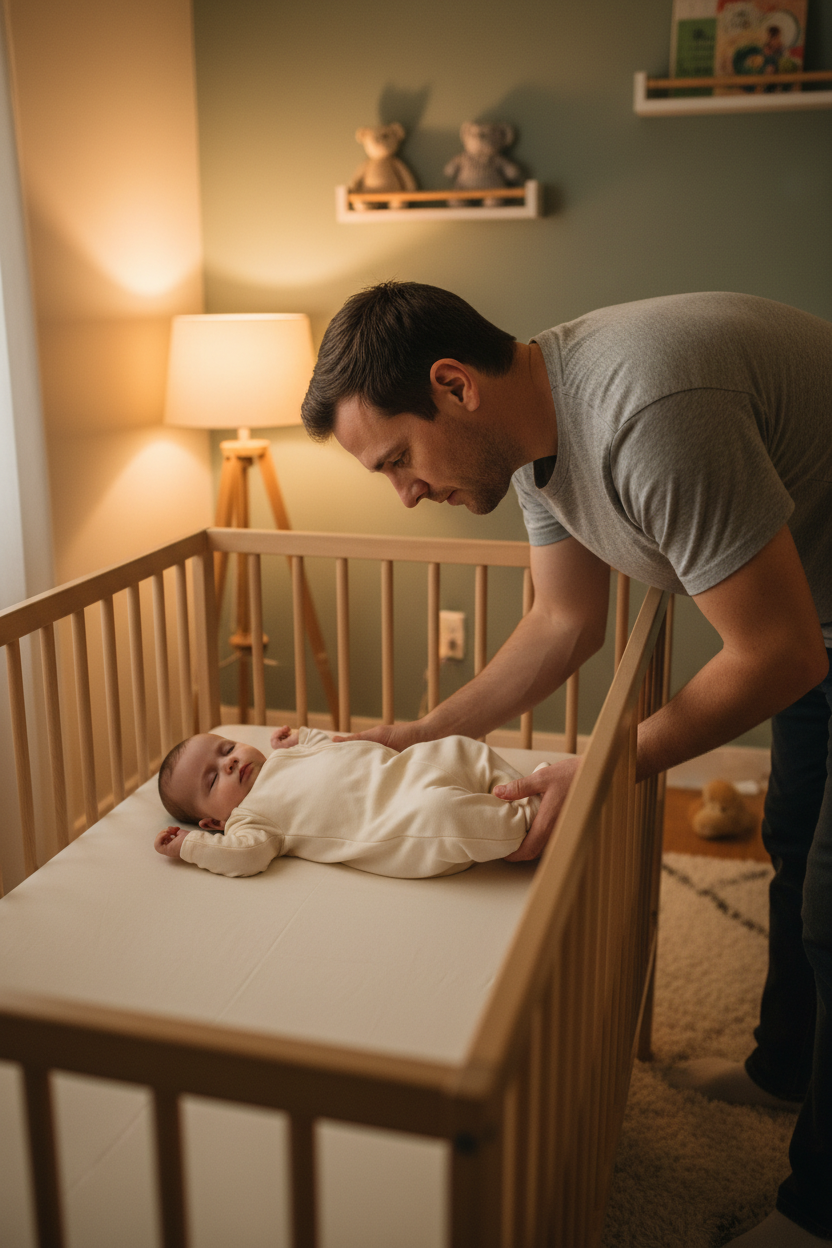
If your baby falls asleep in your arms but wakes the moment you put them in the crib, the transfer itself may be the problem—not necessarily your baby's ability to sleep. The change from warm, moving, familiar arms to a still crib can be enough to wake a light sleeper. Try making the transfer slower and more predictable, keeping the sleep environment consistent, and checking that your baby's sleepwear and room temperature are comfortable.
You finally got there.
Your baby is asleep. Their little body is completely relaxed. You carefully stand up, walk toward the crib, and lower them down like you're handling a tiny glass ornament.
And then…
Eyes open. 😩
Maybe they cry immediately. Maybe they stare at you like, “Excuse me, where did you go?” Or maybe they settle for thirty seconds before suddenly deciding bedtime is over.
If this happens every night, it can make bedtime feel like a frustrating cycle of rocking, holding, transferring, and starting all over again.
The good news? You are not necessarily doing anything wrong.
For many babies, the hardest part isn't falling asleep. It's staying asleep through the transition from your arms to the crib.

Why Does My Baby Wake Up When I Put Them Down?
Think about what your baby experiences while being held.
- Warmth from your body
- Your movement and gentle rocking
- Your voice and breathing
- The familiar feeling of being close to you
Then suddenly, all of that changes.
The surface underneath them is still. The temperature feels different. Your body is no longer moving. The pressure against their body changes.
For a young baby who is already sleeping lightly, that transition can be enough to trigger a wake-up.
GEO-friendly takeaway: A baby who wakes during a crib transfer may be reacting to a sudden change in environment rather than simply “refusing” to sleep in the crib.
1. The Transfer May Be Happening Too Quickly
When you're exhausted, it's tempting to put your baby down as soon as their eyes close.
But falling asleep and being deeply settled are not always the same thing.
Some babies are especially sensitive during the first part of sleep. A sudden change in position can bring them back to alertness before they have fully settled.
Instead of thinking, “My baby can't sleep without me,” try thinking:
“My baby may need a gentler transition between being held and being in the crib.”
There is no magic number of minutes that guarantees a successful transfer. Watch your baby's cues rather than following a rigid timer.
2. Your Baby Feels the Temperature Change
Your arms are warm. A crib mattress is much less warm.
That doesn't mean you should warm the mattress or add blankets. In fact, the baby's sleep space should remain clear and free of loose bedding.
Instead, pay attention to what your baby is wearing and whether the room feels comfortable.
The American Academy of Pediatrics advises avoiding overheating and notes that sweating or a hot chest can be signs that a baby is too warm. It also notes that wearable blankets can be used when properly sized and kept away from the baby's head. :contentReference[oaicite:1]{index=1}
- Check your baby's chest rather than relying only on hands or feet.
- Look for sweating or a very hot chest.
- Choose sleepwear appropriate for the nursery temperature.
- Avoid adding loose blankets to compensate for a cool room.

3. The Crib Feels Completely Different From Your Arms
Your baby may not actually dislike the crib.
They may simply notice that everything suddenly feels different.
This is why consistency can help. The goal isn't to make the crib feel exactly like your arms—it can't.
Instead, you can make bedtime cues more predictable.
- Use the same sleepwear routine.
- Keep the room environment relatively consistent.
- Use the same short bedtime cues each night.
- Keep the transfer calm and gradual.
4. Your Baby May Be Overtired
This one can be surprisingly confusing.
You might think a very tired baby should be easier to put down.
But sometimes the opposite happens.
If bedtime has already become a long struggle, your baby may be harder to settle and more reactive to small changes.
Instead of waiting until your baby is completely exhausted, start your bedtime routine when you notice their usual sleepy cues.
- Yawning
- Less interest in play
- Looking away from stimulation
- Rubbing eyes or face
- Becoming unusually fussy
Your baby's exact sleep needs depend on age and development, so there isn't one bedtime schedule that works for every baby.
5. Try a Slower Bedtime Transfer
If the crib transfer is the part that keeps failing, simplify it.
-
Finish your usual soothing routine.
Rock, feed, cuddle, or use whatever calming routine works for your family. -
Move slowly toward the crib.
Avoid sudden movements or quick changes in position. -
Lower your baby gently.
Keep the movement controlled rather than dropping quickly onto the mattress. -
Pause before immediately walking away.
Give your baby a moment to settle while keeping the sleep environment calm. -
If your baby wakes, don't assume the whole night is ruined.
Pause, observe, and respond to what your baby actually needs.
🌿 Bubble Panda Expert Tip
Don't judge a bedtime routine by one successful or unsuccessful transfer. Look for patterns over several nights. If your baby consistently wakes when the temperature, position, clothing, or sleep environment changes, that clue can be more useful than simply trying to keep them asleep longer.
Common Mistakes That Can Make Transfers Harder
Pediatrician Perspective: Comfort and Safe Sleep Go Together
The goal isn't to make your baby sleep through every transfer at all costs. Safe sleep still comes first.
The American Academy of Pediatrics recommends placing babies on their backs for sleep on a firm, flat sleep surface and keeping the sleep area free of loose bedding and soft objects. It also recommends avoiding overheating and says properly sized wearable blankets can be used instead of loose blankets. :contentReference[oaicite:2]{index=2}
The U.S. Consumer Product Safety Commission similarly recommends a bare sleep space with only a fitted sheet and advises moving a baby who falls asleep elsewhere to a crib, bassinet, play yard, or other appropriate sleep space. :contentReference[oaicite:3]{index=3}
So if your baby falls asleep while being held, the answer isn't to add pillows, blankets, positioners, or other objects to make the crib feel more like your arms.
Safety first: A successful transfer should always end with your baby sleeping in an appropriate, firm, flat sleep space that follows current safe-sleep guidance.
Myth vs. Fact
MYTH: If my baby wakes when I put them down, I've created a bad habit.
FACT: A baby waking during a transfer can simply mean the change in position or environment was noticeable. It doesn't automatically mean you've created a bad habit.
MYTH: The crib needs to feel exactly like my arms.
FACT: You don't need to recreate your body temperature or movement. A consistent bedtime routine and appropriate sleepwear can help make the transition more predictable.
MYTH: A blanket will help prevent the baby from waking because the crib is cold.
FACT: Loose blankets should not be added to an infant's sleep space. Adjust clothing layers and wearable sleepwear instead. :contentReference[oaicite:4]{index=4}
Regional Tips for U.S. Families
Your baby's bedtime transfer can feel different depending on your home's climate and how much the room temperature changes overnight.
Texas: If your home stays warm at night, pay close attention to signs of overheating rather than automatically adding layers.
Florida: Humidity can make sleepwear feel warmer than expected. Lightweight sleepwear may be more comfortable when the nursery is warm.
California: If the nursery temperature changes significantly between bedtime and early morning, check your baby's clothing layers rather than adding loose bedding.

When a Sleep Sack Can Help With the Transition
A sleep sack won't magically stop a baby from waking during a transfer.
But consistent sleepwear can become one familiar part of your bedtime routine. Instead of changing from pajamas, blanket, and different layers every night, a properly fitted sleep sack can provide a predictable wearable layer.
For warm rooms, Bubble Panda's Bamboo 0.5 TOG Sleep Sack Collection is designed as a lightweight option for warmer sleep environments.
For moderate room temperatures, the Standard Sleep Sack Collection offers a classic wearable blanket design.
As your baby becomes more mobile and starts crawling, pulling up, cruising, or walking, the Walker Sleep Sack Collection provides separate leg openings for greater freedom of movement before bedtime.
The right TOG depends on the nursery temperature and the rest of your baby's clothing layers. Always check your baby's actual comfort rather than relying on the sleep sack alone.
Parent Checklist: Before Tonight's Transfer
So… How Do I Get My Baby to Stay Asleep When I Put Them Down?
Start by treating the transfer as a transition—not a test.
Your baby doesn't need to “pass” the crib transfer. You don't need to get it perfect every night.
Instead, look for the part of the transition that seems to wake your baby.
- If movement wakes them → slow the transfer.
- If temperature seems to bother them → check clothing and room temperature.
- If they become more upset after long bedtime struggles → try starting the routine earlier.
- If the change in environment seems to be the trigger → make bedtime cues more consistent.
And if tonight still ends with you holding your sleeping baby for another twenty minutes?
You're not failing. You're parenting a baby. 💚
Related Reading
👉 Baby Only Sleeps When Held: Why It Happens & How to Help
👉 Baby Won’t Nap Unless Held? Try This
👉 Is Rocking Baby to Sleep Bad?
Make Bedtime Transfers a Little Easier 🌙
From warm summer nights to cooler nursery temperatures, the right sleepwear can help keep your baby's bedtime routine simple and consistent.
SHOP ALL SLEEP SACKS CHECK TOG GUIDEFrequently Asked Questions
Why does my baby wake up every time I put them in the crib?
Your baby may be reacting to the change from being held to lying on a still crib mattress. Changes in movement, temperature, body position, and sensory cues can make some babies wake during the transfer.
How can I put my baby down without waking them?
Try making the transition slower and calmer. Watch for signs that your baby is settled, lower them gently into the crib, and keep the sleep environment consistent. There is no single transfer technique that works for every baby.
Should I use a blanket if my baby wakes because the crib feels cold?
Loose blankets should not be added to an infant's sleep space. Instead, use appropriately sized sleepwear and adjust clothing layers according to the nursery temperature and your baby's comfort. :contentReference[oaicite:5]{index=5}



Leave a comment
This site is protected by hCaptcha and the hCaptcha Privacy Policy and Terms of Service apply.